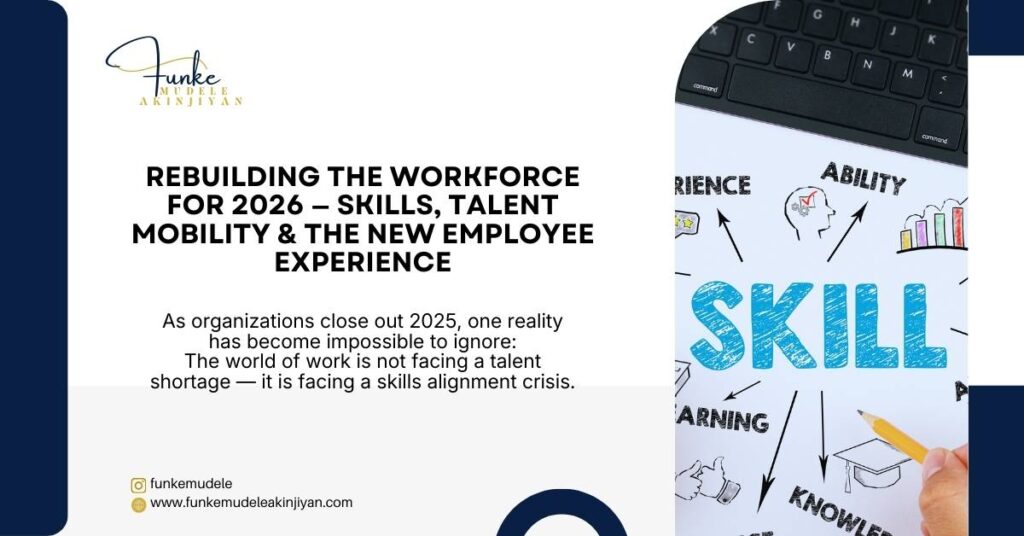
As organizations close out 2025, one reality has become impossible to ignore:
The world of work is not facing a talent shortage — it is facing a skills alignment crisis.
This year revealed a widening gap between the skills employees have and the capabilities organizations urgently need. It also exposed the limitations of traditional workforce models, job descriptions, and talent pipelines that were designed for stability, not speed.
2025: The Year Skills Became a Strategic Currency
Throughout the year, several clear patterns emerged across industries:
1. Competency frameworks became outdated almost overnight
Work changed faster than organizations could update their models.
2. Job descriptions struggled to reflect evolving responsibilities
Static roles couldn’t keep up with dynamic business needs.
3. Employees demanded meaningful development
Employees sought growth, purpose, and opportunities — not just titles.
4. Talent mobility shifted from “nice-to-have” to “business critical”
Moving people to where capability was needed became essential for performance.
5. Coaching and continuous feedback grew in importance
Employees needed real-time guidance more than annual reviews.
The message was clear:
Organizations can no longer treat talent as fixed. They must treat capability as fluid, adaptable, and continuously evolving.
What 2026 Will Demand From Organizations
To thrive in 2026, leading organizations will adopt a fundamental mindset shift — one that transforms how they define, develop, and deploy talent.
From jobs → to skills
Skills will become the unit of measurement for workforce planning, hiring, and development.
From hierarchy → to mobility
Fluid career pathways will replace rigid ladders, enabling movement across functions and roles.
From training → to capability building
Learning will no longer be a single event. It will become an integrated, ongoing system tied to business priorities.
From experience → to learning agility
The ability to adapt, learn quickly, and apply new knowledge will outweigh past roles or tenure.
From retention → to engagement and meaning
Employees will stay where they feel purpose, fairness, growth, and psychological safety.
The Workforce of 2026: Purposeful, Skilled, and Mobile
The organizations that succeed in the new year will not be those with the largest teams —
but those with the most aligned, agile, and future-ready capabilities.
They will build systems that prioritize:
- Skill visibility across the workforce
- Internal talent marketplaces that match people to opportunities
- AI-powered learning pathways that personalize development
- Capability academies aligned to strategic priorities
- Employee experiences that foster belonging, growth, and meaning
The future of work is no longer about filling roles.
It is about building capabilities at scale and ensuring people can move, grow, and contribute in ways that create value — for themselves and for the organization.
As we step into 2026, one truth stands out:
The organizations that treat talent as dynamic will shape the future. Those that remain static will struggle to keep up.